The 60-Second Data Deluge: AI and the Internet’s Minute-by-Minute Facts
Statistics
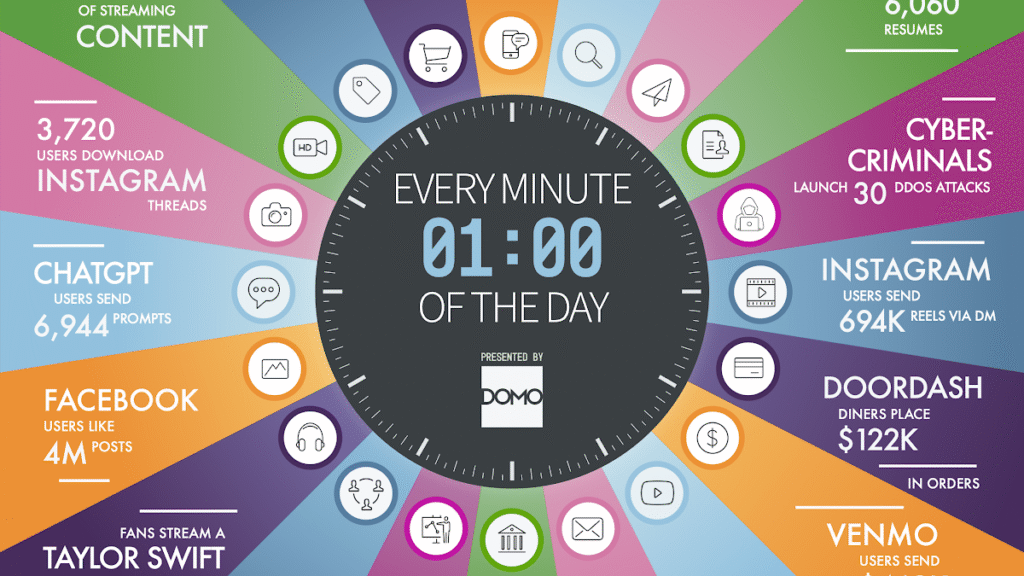
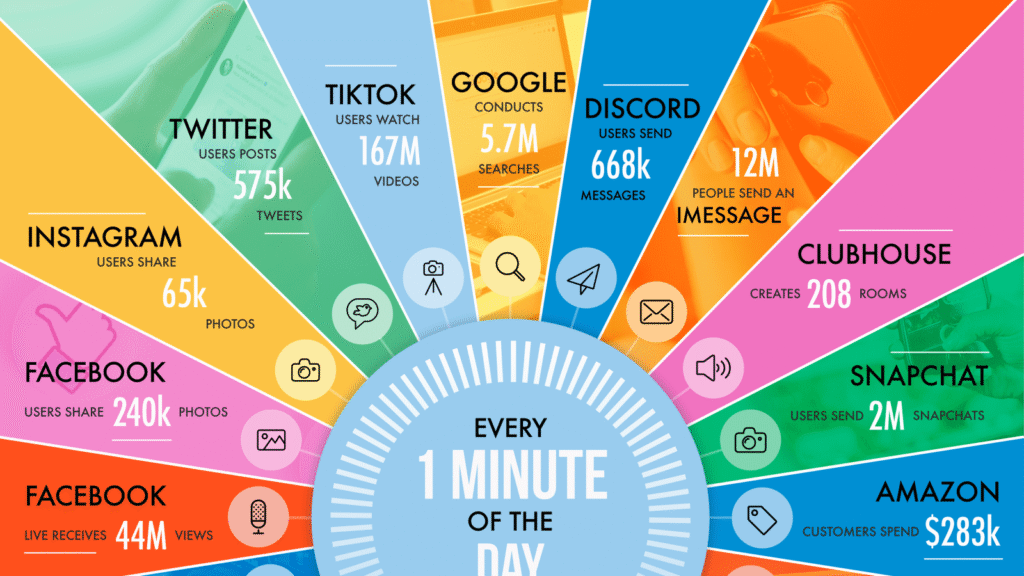
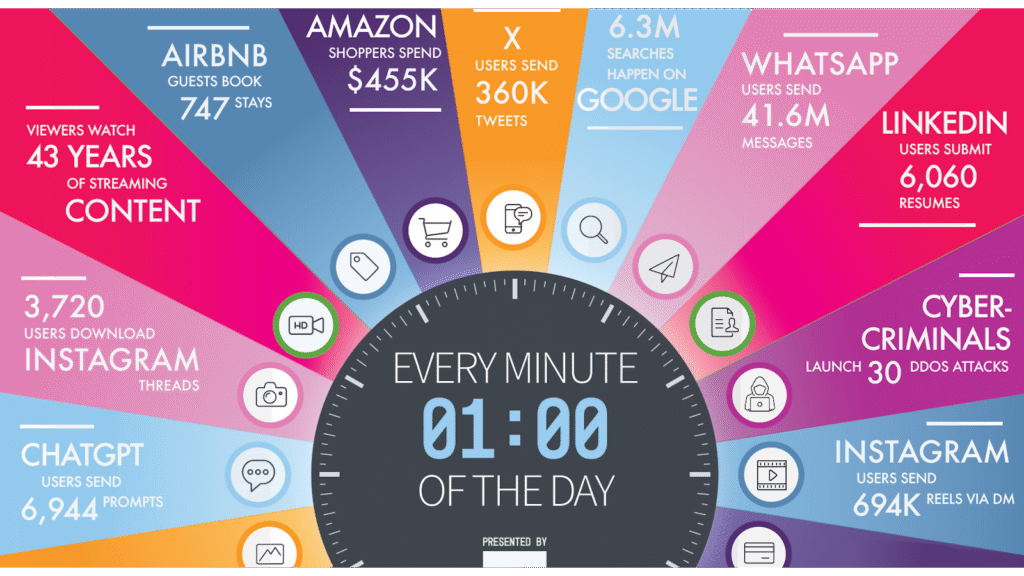
| Platform / Activity | What Happens Every 60 Seconds (Current 2025 Statistics) | Notes |
| More than 6.3 million searches performed | A massive surge in daily searches (over 6.3 million per minute), highlighting its role as the world’s information hub. | |
| More than 69 million messages processed | This figure represents a massive volume of messages exchanged globally. | |
| More than 231.4 million e-mails sent | This figure includes both spam and legitimate messages, demonstrating the sheer volume of daily digital communication. | |
| YouTube | More than 360 hours of videos uploaded | This is an incredible amount of content added per minute! |
| YouTube | More than 5.2 million hours of videos watched | The consumption is mind-bogglingly higher than the upload rate! |
| Twitter (X) | More than 350,000 tweets sent | The platform maintains a high-velocity stream of global conversation. |
| More than 695,000 Stories and Reels posted and viewed | This combined number reflects the explosive popularity and consumption of the short-form, ephemeral content formats. | |
| App Downloads | Approximately 570,138 apps downloaded | Based on the 2025 projection of 299 billion annual downloads (299,000,000,000÷365÷24÷60 is approx. 570,138) |
| Approximately 6 new people hired | While new accounts are harder to pinpoint, a compelling statistic is that an average of 6 people are hired every minute through the platform. |
It’s time to pause and think about the sheer, mind-boggling scale of our digital lives. You know how fast a minute flies when you’re scrolling through your phone, right? Well, that single, fleeting sixty seconds is a frantic maelstrom of data generation, artificial intelligence processing, and global connectivity. If the internet were a beating heart, its pulse would be so rapid and powerful that it would dwarf anything we’ve ever conceived.
We often talk about data in terms of “daily” or “yearly” figures—zettabytes and quintillion-dollar markets. But when you break it down to the raw, visceral metric of what happens every 60 seconds, you get a true feel for the velocity of the future. It’s not just a statistic; it’s an immediate, continuous revolution happening right now, whether you’re consciously online or not.
This article isn’t just a list of facts; it’s an attempt to grasp the unrelenting, non-stop data deluge that defines the 21st century. We’re going to dissect this precious minute, starting with the most disruptive force on the planet: Artificial Intelligence and its Agentic Revolution, and ending with the personal, sometimes frivolous, activities that make up our digital and social media footprint. Prepare yourself, because the numbers are simply staggering.
The AI Revolution: What Happens in an Agentic Minute?
The narrative around Artificial Intelligence has shifted from theoretical possibility to tangible, active engine of the global data flow. In this minute we’re analyzing, AI systems aren’t just sitting idle; they are actively learning, generating content, and executing tasks. The data flow here is less about passive consumption and more about intensive, computational activity.
ChatGPT and the Generative Surge
If you want a single snapshot of the AI boom, look no further than the Large Language Models (LLMs) that have captured the world’s imagination. These systems are devouring prompts and spitting out responses at a rate that is frankly terrifying in its speed.
Just one LLM, like ChatGPT, handles a colossal volume of interactions. Consider this: In an average minute, the ChatGPT website alone receives an estimated 134,259 visitor requests. Think about that. That’s more than 2,200 requests every single second, twenty-four hours a day. It’s a torrential downpour of questions, content generation, coding requests, and intellectual labor that puts the previous decade’s tech booms to shame. This immense, minute-by-minute engagement demonstrates how rapidly AI has become a utility, woven into the fabric of human research, work, and even creativity. It’s the ultimate co-pilot, churning out data on demand.
The Rise of Agentic AI: Autonomous Decisions
The next major wave, and the one most deeply tied to the “per minute” efficiency metric, is Agentic AI. This isn’t just a chatbot; it’s a sophisticated system that can break down a complex goal, invoke multiple tools, and execute a sequence of actions with minimal human oversight. These autonomous agents are the future of corporate efficiency, and their data impact is about transaction volume and time savings.
Autonomous Decisions in the Enterprise
While hard, specific “transactions per minute” numbers are closely guarded corporate secrets, the measurable impact is clear. Industry analysts project that a significant percentage of day-to-day work decisions—up to 15%—will be made autonomously by AI agents by 2028. This means that in our 60-second window, hundreds of sophisticated decisions—from inventory reordering to fraud detection to financial portfolio rebalancing—are being executed without human intervention. The speed of these actions is staggering. Case studies show that AI agents can execute tasks like trip planning or budget optimization with a 70% time saving compared to manual processes. That’s not just a minor tweak; that’s an industrial-scale leap in velocity happening every minute.
Voice Assistants: Always Listening, Always Processing
Even the most mundane interactions are AI-driven. The global number of digital voice assistants in use (like Alexa, Siri, or Google Assistant) has exploded to over 8.4 billion! While not every one is active in a given minute, a huge percentage of the world’s population is relying on these agents to set reminders, check the weather, or play music. Every Weather Channel request, every “Hey Siri,” is a micro-data transaction that feeds the colossal AI processing pipeline, further cementing the fact that AI is not an optional tool—it’s the infrastructure of modern life.
The Economic Engine: AI’s Financial Footprint
The underlying driver of this minute-by-minute activity is, predictably, money. The global AI market is now worth hundreds of billions of dollars, and it’s growing at an annual rate that outpaces most traditional industries. Every query, every transaction, every autonomous decision we just talked about is adding to a market that is projected to continue its exponential growth. The massive investment in AI hardware and software infrastructure means that the capacity for this minute-to-minute data processing is not slowing down—it’s only accelerating. The velocity of data is directly correlated to the velocity of capital.
The Internet’s Core Pulse: Global Data Flow in 60 Seconds
If AI is the brain, the global internet is the nervous system, and it’s running at an unimaginable speed. The figures here represent the fundamental fuel for all the AI systems and social media platforms we use. This is the background hum of the entire digital world.
The Petabyte Pipeline: Traffic Volume
When you total up all the emails, videos, searches, and social posts, the sheer volume of data moving across the globe every minute is breathtaking. Global internet traffic has swelled to an incredible 9 to 10 petabytes of data consumed every single minute worldwide.
To give you some perspective, one petabyte is 1,000 terabytes (TB), or one million gigabytes (GB). So, every 60 seconds, nearly 10 million gigabytes of data are zipping across fiber optic cables, wireless networks, and satellites. This massive, ceaseless pipeline of data ensures that your quick Google search is answered, your video streams without buffering, and your remote work collaboration remains seamless. The velocity of this data is what makes the modern world possible.

Search and Connectivity: The Google Gold Rush
What do people do with all that bandwidth? A huge portion of it is dedicated to the constant, relentless pursuit of information.
The Email Avalanche: Professional and Personal Data
Email, the digital dinosaur of communication, is far from extinct. In fact, it remains one of the largest forms of data transfer. In just one minute, an estimated over 149,513 emails are sent and received globally. Crucially, a significant portion of this deluge—millions of messages—is pure spam, meaning the infrastructure must constantly process and filter an incredible amount of junk data alongside legitimate communication. This minute-by-minute flood highlights the persistent challenge of digital noise.
Streaming and Entertainment: Data Consumption
Our hunger for streaming content is perhaps the biggest bandwidth hog. In a single minute, consumers are watching approximately 3.4 million YouTube videos. That figure is purely the consumption side. Now consider the massive data needed for streaming services like Netflix, Disney+, and others, or the 600 new page edits happening on Wikipedia every minute. We are not just accessing information; we are drowning in entertainment, creating an almost unimaginable consumption rate that places enormous pressure on global internet bandwidth.
The Social Vortex: Digital & Social Media’s Unrelenting Cycle
This is where the macro data flows down to the micro-level—your phone. Social media is the most accessible, viral, and fast-moving component of the internet’s minute-by-minute activity. It’s where human attention is captured, monetized, and relentlessly recycled.
The Messaging Mania: Real-Time Communication
Forget formal letters or long phone calls. In our 60-second window, the primary mode of global communication is instant messaging. On platforms like WhatsApp alone, over 97 million messages are sent. That is almost two million messages per second—and that’s just one platform! This colossal figure demonstrates the fundamental human need for immediate connection, mediated by hyper-efficient digital services. It’s a silent, global conversation happening constantly, a dense river of text, photos, and emojis.
Ephemeral and Endless Content: Platform-Specific Facts
Each platform carves out its own niche in the minute-by-minute digital world, proving that human creativity and attention are limitless.
- Instagram’s Visual Feast: Users are posting and consuming a constant stream of visual data. An estimated 46,740 photos are uploaded to Instagram every 60 seconds. This is the minute-by-minute creation of the world’s visual diary, generating massive amounts of high-definition storage data.
- The X/Twitter Firehose: Despite any changes, the core function of X (formerly Twitter) remains instant, reactive text. Every minute, the platform sees around 456,000 new tweets or posts. It’s a real-time, global consciousness, responding instantly to news, trends, and outrage, often dictating the flow of conversation in a matter of seconds.
- Facebook’s Enduring Legacy: Even as new apps emerge, the old guard maintains incredible volume. On Facebook, users are generating 510,000 new comments and updating 293,000 statuses each minute. It’s a mature platform, yet its minute-by-minute activity far surpasses many newer players due to its sheer scale of users (over 3 billion active users!).
The Business of Connection: LinkedIn and Professional Data
It’s not all cat videos and commentary. The professional world is moving at speed, too. LinkedIn, the world’s largest professional networking platform, welcomes over 120 new members every minute. This constant influx of professionals, seeking new connections or opportunities, shows that the data velocity of the internet is driving economic mobility just as much as entertainment.
Global Digital User Growth: New Accounts Every Minute
Finally, let’s look at who’s joining this digital party. While the growth rate is slowing in highly developed nations, the global user base continues to swell. Every second, globally, we see an average of 8.4 new social media users join the fold. That means in one minute, over 500 new people are getting their first taste of this data-driven reality, further fueling the statistics we’ve just reviewed. The minute-by-minute growth is a powerful reminder that the digital world is a constantly expanding frontier.
Why These Minutes Matter: The Velocity of the Future
Stepping back from the staggering numbers, why should we care that 9 petabytes of data are moving every minute or that 134,000 AI prompts are being processed? We should care because the velocity of this data dictates the velocity of our reality. The sheer speed of these transactions—from a fraction of a second for a Google search to a few minutes for an AI-generated draft—is collapsing time, making instantaneity the new norm.
The Blurring Line Between Human and Agent
This ultra-fast data flow, particularly the rise of Agentic AI, is fundamentally changing human interaction with the internet. We are moving from a model where we consume data to one where we delegate tasks to intelligent systems. Our lives are becoming increasingly orchestrated by algorithms and agents that operate within this 60-second window, managing our finances, communication, and even our health. The challenge isn’t just coping with the data; it’s learning to trust, regulate, and safely co-exist with the tireless, minute-by-minute efficiency of these autonomous systems.
A Final Second of Reflection
Take a deep breath. In the time it took you to read these last few paragraphs, millions of AI-driven calculations were performed, billions of messages were sent, and gigabytes of video were streamed. The 60-second digital world is not just large; it is hyper-kinetic. It is the crucible where human ambition, technological innovation, and an unrelenting torrent of data converge. Understanding this minute-by-minute reality isn’t just about winning at SEO; it’s about grasping the core mechanisms of the world we now inhabit. The future is not coming—it’s arriving, sixty seconds at a time.
Frequently Asked Questions (FAQs)
Q1: How much of the “per minute” internet data is AI-generated versus human-generated?
The line is rapidly blurring! While raw user-to-user traffic (like WhatsApp messages and emails) is still heavily human-driven, a massive and growing portion of the internet’s overall volume and computational load is machine- or AI-generated. This includes every AI-assisted response, automated social media post, agentic transaction, and the massive data required to train and run the LLMs, which is a continuous, minute-by-minute background process.
Q2: Are Agentic AI systems replacing human search volume (e.g., Google searches) yet?
Not entirely, but they are beginning to intercept the intent behind the search. While Google still processes millions of searches per minute, many tasks that used to require multiple searches (like researching a topic or planning a trip) are now being consolidated into a single, complex prompt to an Agentic AI. This suggests AI is shifting from being a search tool to a task executor, but the overall need for information still generates colossal minute-by-minute data volume.
Q3: What is the most bandwidth-intensive activity that happens every minute?
Video streaming (including YouTube and platforms like TikTok) and cloud computing/data transfer are, by far, the most bandwidth-intensive activities. High-definition (HD) and Ultra HD video streams consume vast amounts of data per second, and when multiplied by millions of users watching concurrently in a minute, this consumption easily outpaces text messaging or even simple image uploads.
Q4: Given the sheer number of emails sent per minute, how does the internet handle so much spam?
The immense volume of emails, including spam, is handled by sophisticated, AI-driven filters that operate in real-time. These filters are themselves high-speed Agentic systems that process millions of messages per minute, classifying, blocking, and diverting spam before it ever reaches a user’s inbox, proving that AI is essential for managing the minute-by-minute chaos it sometimes contributes to.
Q5: If the internet’s data volume is growing exponentially per minute, is there a physical limit to the growth?
While the rate of data generation is astronomical, we are constantly pushing against the limits of physical infrastructure. Innovations in fiber optics (like increasing the capacity of existing cables) and the continuous expansion of hyperscale data centers are what allow the minute-by-minute growth to continue. However, the energy consumption required to power the AI and data center activity is a significant, looming limit that requires constant technological and policy innovation.